 Donato Blandolino
Average project managers fight fires. The best ones make sure there is nothing to burn. Why organisations systematically reward the wrong behaviour and what real project leadership looks like.
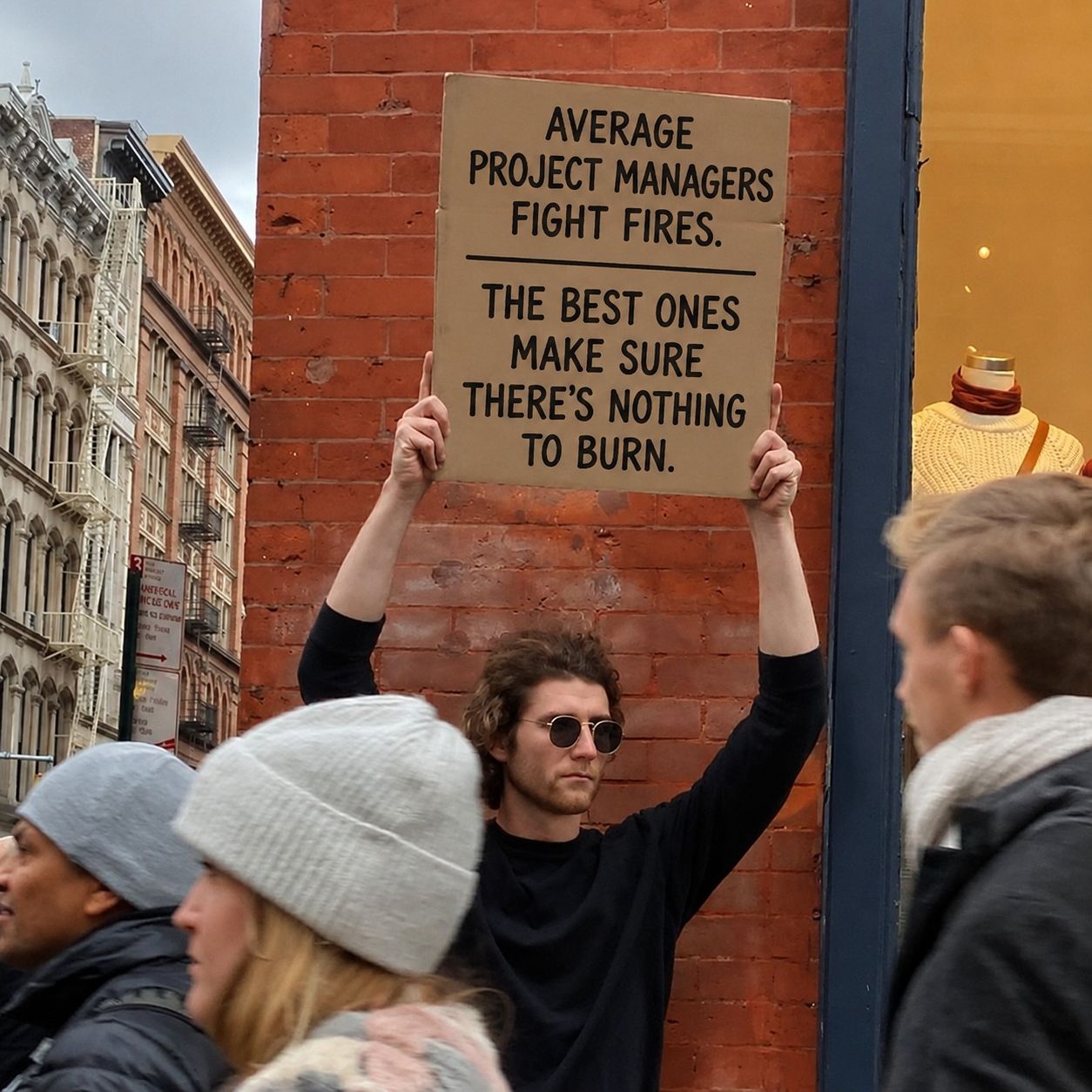
A cardboard sign in New York recently carried a sentence that belongs in every production hall: Average project managers fight fires. The best ones make sure there is nothing to burn. It sounds like a nice saying. In fact, it describes quite precisely why most production projects fail. Not because of a lack of competence. Not because of a lack of methods. But because organisations systematically reward the wrong behaviour.
Our image of a good project manager is wrong
We admire the person who keeps track of everything amid the chaos. Who resolves an escalation at half past ten at night because the supplier is not delivering and the line would otherwise be at a standstill the next morning. Who saves the project from the flames just in time and explains to the steering committee afterwards how close it was.
That is impressive. We have worked with people like that, and we have been in those situations ourselves. And we still say: it is treating the symptoms. A truly good project manager barely stands out. Very little escalates on their watch because they see problems before they escalate. Because they ask the right questions from the outset, put the right structure in place and clarify responsibilities before things get painful. Their projects are unremarkable. They simply run.
Prevention never looks heroic
This is where the real problem lies. A fire that never breaks out gets no applause. It does not appear in any status report, and there is no crisis meeting where someone could earn recognition. There is simply nothing to report.
The rescuer, by contrast, is visible. Their contribution makes a story, complete with the time, the drama and an outcome that would have been different without them. They get promoted. The other person, on whose watch nothing ever catches fire, is all too easily seen as someone who had an easy project. And that is precisely why many organisations reward the wrong people. They celebrate the firefighters and overlook those who make sure no fire breaks out in the first place. Over time, everyone in the company learns what pays off. Anyone who wants to be visible needs a fire. Anyone who does not have one waits until one starts.
In production, this is particularly expensive
In a consulting project, an escalation costs you nerves. In production, it costs money, immediately and measurably. A line that is down for three days because a qualification process was started too late cannot be saved by good crisis management. The downtime has already happened. All you can do is manage it. A plant relocation in which responsibilities between the sending and receiving sites were never properly clarified creates months of friction that even the best escalation process cannot contain. A ramp-up where nobody asked beforehand whether the supply chain could actually support the ramp-up curve does not end with a solvable problem, but with a customer walking away.
Every crisis avoided saves more than even the best crisis resolution could ever deliver. That is not a matter of attitude, it is arithmetic.
How to tell whether you are celebrating the wrong people
Three questions that any organisation can answer without a project or a workshop.
- First: who was last praised for a project in your organisation, and what exactly for? If the answer is a rescue story, you know what behaviour you are cultivating.
- Second: how often do you sit in meetings that would not exist without an urgent problem? If a large part of your project communication consists of escalations, you are not managing projects, but their consequences.
- Third: for every work package, do you know who makes the decision when things get stuck? Not who is in charge. Who makes the decision. One name. If the answer to that question is a department, the next fire has already been set.
What to do instead
The work that prevents fires is unglamorous and happens early. It essentially consists of three things.
Responsibility is assigned to individuals, not functions. One name per work package, which still applies when things get uncomfortable. Nothing generates escalations as reliably as shared responsibility.
Problems are reported while their status is still amber. In most organisations, the status jumps straight from green to red because amber is seen as a weakness. That is precisely where change can make a difference: anyone who is allowed to report amber without being penalised will report early enough for the cost to remain low. This cannot be ordered, it has to be demonstrated through action, by the person at the top.
And it is the assumptions that are checked at the start, not the deadlines. A Gantt chart has never saved a project. It shows what is supposed to happen, not whether it can happen. The questions that matter are: can the supply chain support this curve? Is the team qualified for this process, or does it just say so on a slide? What happens if this one machine breaks down?
How we approach this
We come from the operational front line. Goods receipt, logistics, production. We have put out enough fires to know that firefighting is the worst part of the job. That is why our work in the first few weeks of an assignment often looks unremarkable. We are on the shop floor, we ask about responsibilities, we test assumptions that nobody has questioned for months. This does not produce a presentation. It produces projects that do not escalate later.
This is precisely where the difference from a traditional large consultancy lies. A concept that describes the crisis has never saved a site. We take operational responsibility, we stay until things are running, and the measure of success is not the report at the end, but whether things are still running after we have left.
Competence is the prerequisite here, not the differentiator. Whether someone on the shop floor asks the right questions early enough and voices the uncomfortable answer even when nobody wants to hear it comes down to personality. Personality First.
The real skill
It is not about managing the chaos. It is about making sure it never arises in the first place. Who do you celebrate in your projects: the person who puts out the fire, or the person on whose watch no fire ever breaks out?
About SMART iNTERIM
SMART iNTERIM Management supports manufacturing companies through operational transformation: restructuring, plant establishment, plant relocation, turnaround and process optimisation. We bring hands-on experience, not a distant perspective, and take operational responsibility rather than make recommendations. Headquarters in Switzerland, branch in Dubai.