 Donato Blandolino
New process introduced, 120 employees trained, three months later everything runs as before. Why training does not change behaviour and which four levers actually work.
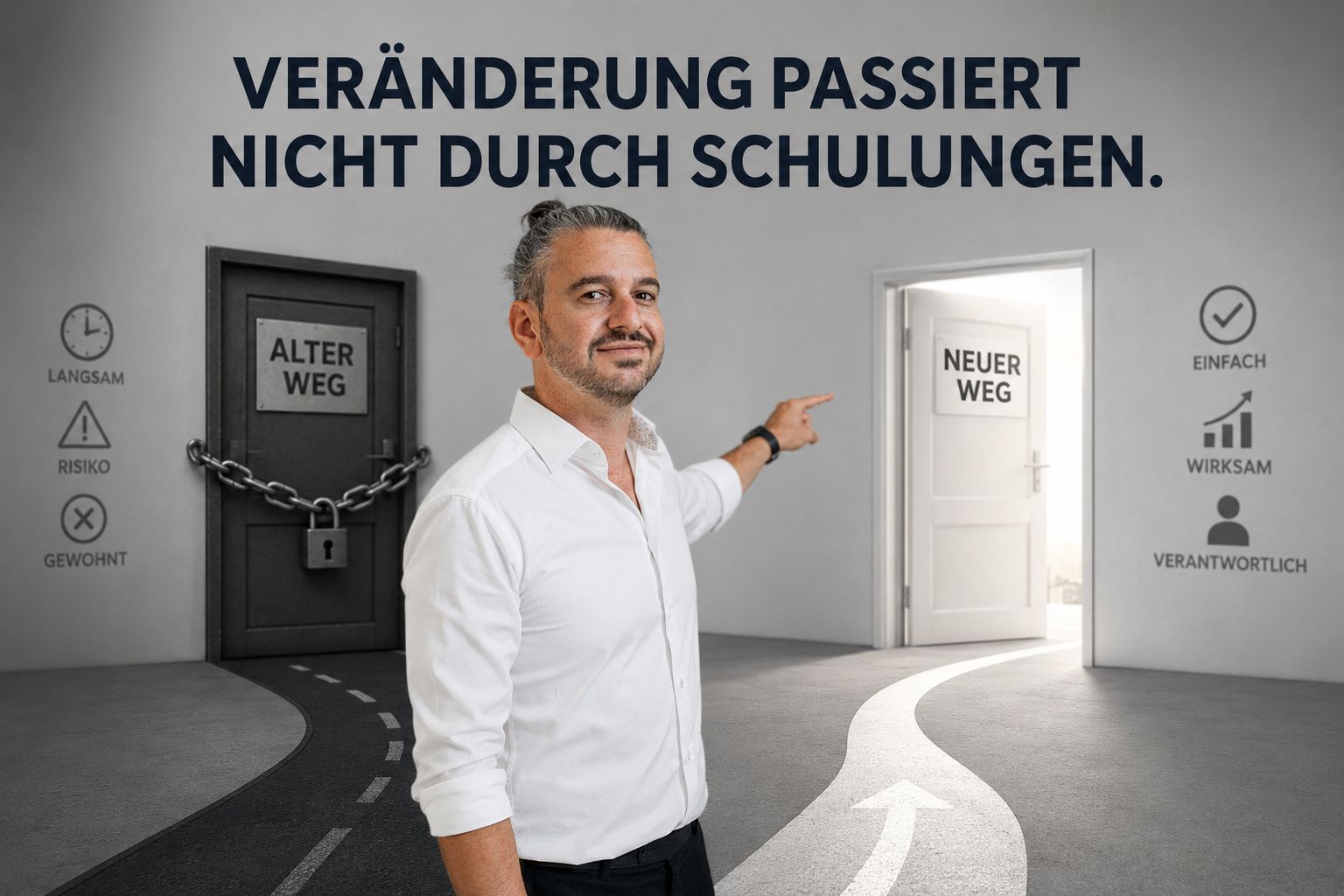
New process introduced, 120 employees trained, the presentation went well, the attendance register is complete. Three months later, everything is back to how it was before. And management wonders why people are not getting on board.
They are getting on board. Just with whatever pays off for them. In this article, we at SMART iNTERIM explain why training does not change behaviour, the single question you can use to check in one minute whether your change will hold, and which four levers actually work.
Why does training not change behaviour?
Training changes knowledge. Behaviour changes through structures.
As long as the old way is technically possible, faster and safer for the individual, people will take it. That is not stubbornness; it is common sense. Anyone under deadline pressure with two paths in front of them will take the one that keeps them out of trouble today.
The flawed thinking lies in assuming that people follow instructions. They follow the path of least resistance. So anyone who wants change needs not to persuade people, but to reroute the path.
The test that takes one minute
Ask yourself this question: What exactly happens if someone goes back to doing things the old way tomorrow?
If the honest answer is “nothing”, you have not managed change; you have managed risk. You have covered yourself by ensuring that everyone was informed.
That is a distinction with consequences. Distributing information protects management after the event. Changing structures protects the outcome.
The four levers that actually work
In this order:
- Close off the old way, rather than banning it. Technically or organisationally. A ban is a request in a stern tone of voice. A blocked transaction, a removed paper document and a changed approval logic are facts.
- Change the metric used to measure performance. Anyone assessed on unit output will optimise unit output, regardless of what the training said. The metric beats any presentation.
- Assign one name to each change, not a department. “Production will implement this” means nobody will implement it. Responsibility needs a face and a date.
- Make the new way the easiest, not the prescribed one. If the right way takes three more clicks than the wrong way, it loses. Every day, with every employee.
Why metrics beat any training
Of these four levers, the second is the most frequently overlooked. Companies introduce new processes and leave their old target-setting systems unchanged.
The result is a conflict between objectives that employees have to resolve every day, and they resolve it in favour of whatever they are assessed on. If you want to improve throughput time but continue to manage by machine utilisation, you get utilisation. If you want to reduce inventory but use delivery capability as your only hard metric, you get inventory.
A change that leaves the target-setting system untouched is not a change. It is a request.
How to tell that your change is not holding
Three observations are usually enough:
- Working routes around the new process still exist, and people are using them.
- When asked who is responsible for a particular change, people name a department, not a person.
- The agreed objectives for the current year contain nothing that has changed as a result of the change initiative.
If two of these apply, the process will be back to how it was before within a few months.
How SMART iNTERIM embeds change
We take on transformations not as a conceptual exercise, but as a line management responsibility. In practical terms, this means we are accountable when a measure does not work, and we are still there when it needs to work.
Our interim managers have hands-on backgrounds; many started in goods receiving, logistics and production themselves before going on to manage and restructure plants. They know why employees take the old way because they have taken it themselves.
That is why we start not with training plans, but with three questions: Which old way is still open? Which metric is working against the change? And who exactly is responsible for which change, with a name and a deadline? Only then do we talk about communication.
Frequently asked questions about change management in production
Why do change projects fail despite good training?
Because training imparts knowledge, but behaviour is governed by structures. As long as the old way is possible, faster and less risky, people will use it, regardless of what they were taught in training.
How can I tell whether a change is truly embedded?
With one question: What exactly happens if someone goes back to working the old way tomorrow? If the answer is “nothing”, the change is not embedded.
Which is more important, communication or structure?
Structure. Communication explains a change; structure enables it. A well-communicated change without a structural foundation fails; a structurally embedded change with poor communication is hard work, but it holds.
Why is banning the old process not enough?
Because a ban requires someone to enforce it, and under the pressure of day-to-day operations, someone rarely does. If the old way is closed off technically or organisationally, the question of enforcement disappears.
What role do metrics play in change projects?
A decisive one. People align their behaviour with what they are measured on. If the target-setting system remains unchanged, it works against every new requirement.
How long does it take for a change to hold?
That depends less on time than on structure. If the old way is closed off and the metric adjusted, the change takes effect within a few weeks. Without both, it will not take effect even after a year.
About SMART iNTERIM
SMART iNTERIM Management combines operational transformation with SAP and enterprise transformation in manufacturing companies, focusing on restructuring, plant set-up, plant relocation and process optimisation. We take responsibility for the outcome, not the recommendation, and work where value is created. From hands-on experience, not from a distance. Competence is a prerequisite; personality makes the difference. Talk to us if a change has been agreed in your company but is not taking effect in day-to-day operations.