 Donato Blandolino
When change fails to take hold, the usual response is more training. Why this rarely works, how genuine change management differs from pure risk management and how transformation in production actually succeeds.
When a change in a company fails to take hold, the response is almost always the same: we need to train employees even better. That sounds logical, but it is usually the wrong answer. Because the uncomfortable truth is that much of the training in change management is a waste of time. Not because the content is poor, but because it does not address the actual problem at all.
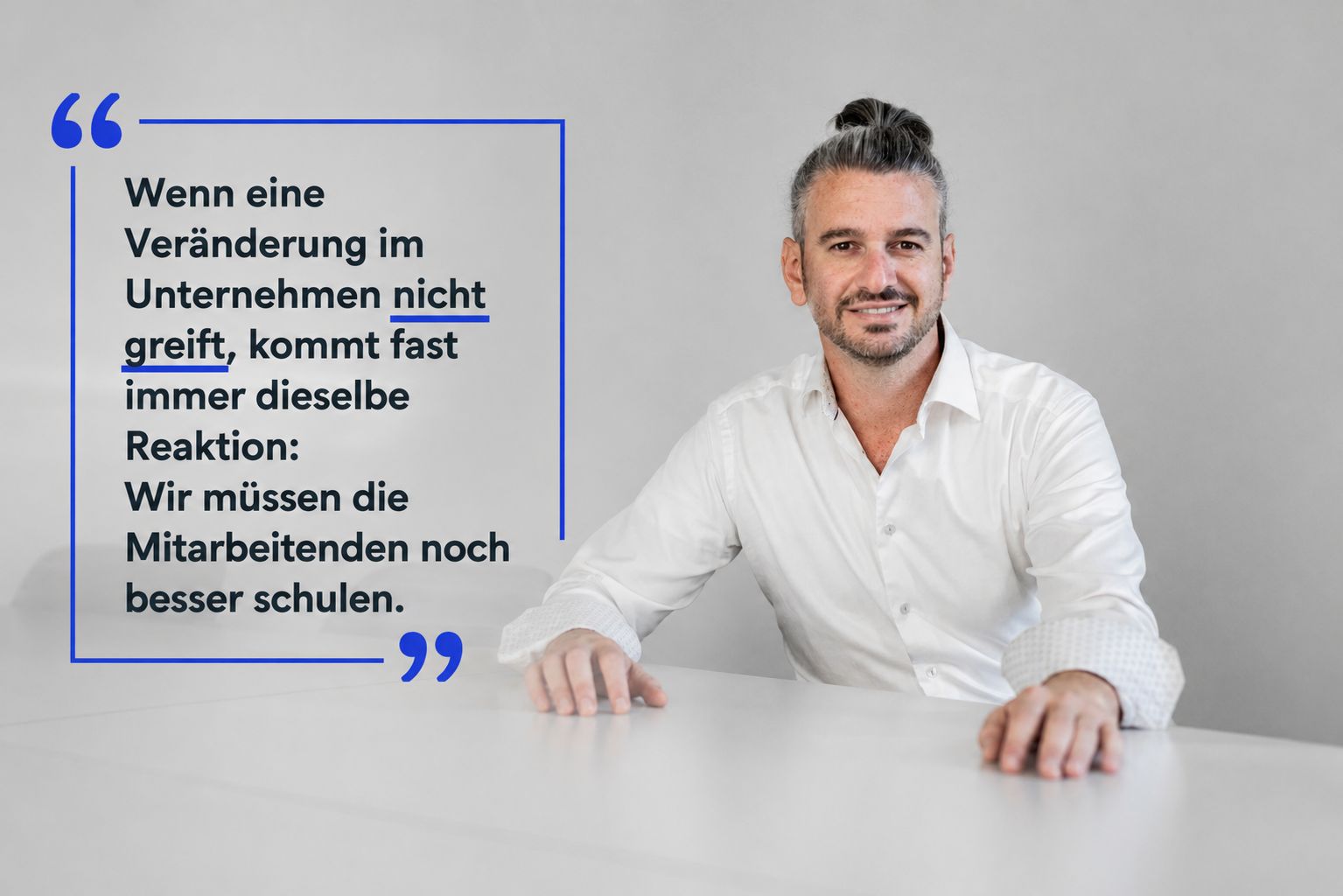
In this article, we at SMART iNTERIM show why more training is rarely the solution, how genuine change management differs from pure risk management and how change in manufacturing companies actually succeeds: not through slides, but through structures.
Why training in change management often remains ineffective
What happens in many transformations is this: new processes are imposed on old structures, and people expect it to work. When it does not work, training is provided. And when it still does not work, even more training is provided.
But the problem is not employees’ lack of knowledge. People do not change their behaviour because they have sat in a training room. They change it when the structure around them makes the new behaviour possible, sensible and easier than the old behaviour. As long as the old process is more convenient, the old process wins. Any training that tries to counter this is wasted time.
Change management or risk management: the crucial difference
When training alone is used to safeguard change, it is no longer change management. It is risk management. People protect themselves, document that everyone has been informed and hope that responsibility has thereby been shared.
The difference is fundamental:
- Risk management asks: have we informed everyone and documented that training has taken place? The aim is protection.
- Change management asks: have we changed the conditions so that the new behaviour becomes the natural choice? The aim is actual change.
Both have their place, but only the latter really changes anything. Those who confuse protection with change put a great deal of effort into training and then wonder why everything stays the same in day-to-day work.
Why real change starts with structure, not a presentation
Real change does not start with a presentation. It starts by changing structures so that the desired behaviour becomes the natural choice. Only then does training become effective, because it explains something that already makes sense in day-to-day work.
If you want to change behaviour, you must first change the conditions. Not the slides.
This means designing processes, workflows, tools and responsibilities so that the new way is the easiest. When this succeeds, behaviour follows almost by itself, and training shifts from being the main tool to a useful complement.
What this means for transformations in production
This mechanism is particularly evident in manufacturing companies. A new planning system, a new shop floor concept or a changed layout rarely fails because of employees’ knowledge. It fails because the old ways remain possible and more convenient.
As long as the previous process remains available, the team will fall back on it when in doubt, not out of resistance, but out of pragmatism. Effective transformation therefore means reshaping the conditions so that the new way becomes the logical choice. This is work on the structure, not on the presentation, and it takes place on the shop floor, not in the meeting room.
How SMART iNTERIM implements change effectively
At SMART iNTERIM, we see change management as an operational task, not a communication exercise. Our interim managers have worked their way up from the shop floor and have managed, restructured and relocated plants themselves. They know from first-hand experience that change only lasts when day-to-day conditions are right.
That is why we start with the structures: processes, workflows, responsibilities and tools. We shape the conditions so that the desired behaviour becomes the obvious choice, and support implementation directly on the production line. Training is used where it explains something that already makes sense in day-to-day work. Through hands-on practice, not from a distance.
Frequently asked questions about change management and training
Why does change fail despite extensive training?
Because training addresses knowledge, not conditions. People do not change their behaviour because they have sat in a training room, but when the structure around them makes the new behaviour easier than the old. As long as the old process is more convenient, it will prevail.
What is the difference between change management and risk management?
Risk management provides safeguards and documents that everyone has been informed. Change management alters the conditions so that the desired behaviour becomes the obvious choice. Only the latter leads to actual change.
Is training unnecessary in change management?
No. Training is effective when the structures have been adapted first. It then explains something that already makes sense in day-to-day work. As the sole remedy for stalled change, however, it is usually a waste of time.
How can change succeed in manufacturing companies?
By first reshaping the conditions, meaning processes, workflows, tools and responsibilities, so that the new way is the easiest. This work takes place on the shop floor, not in a presentation, and ideally receives hands-on operational support.
What does the statement “If you want to change behaviour, you must first change the conditions” mean?
It captures the essence of effective change: it is not communication that determines the success of a transformation, but structure. Only when the desired behaviour becomes the obvious choice will it endure.
About SMART iNTERIM
SMART iNTERIM Management stands for operational transformation and interim management in manufacturing companies, with a focus on restructuring, plant set-up, plant relocation and process optimisation. We see change management as an operational task and tackle change where it originates: in the structures and on the shop floor. Through hands-on practice, not from a distance. Our guiding principle: competence is the prerequisite, personality makes the difference.